6 Daily Standup Tools for Remote Teams in 2026
By The Quely Team — Quely editorial team
The best daily standup tool depends on what your team is missing. Use a bot for structured updates, or use a connected work layer when decisions, risks, blockers, and ownership are split across systems.
Updated July 2026: We refreshed Quely’s product model, removed fragile exact-price claims, and updated the comparison year. Verify current plans, ratings, integrations, and security details with each vendor.
Remote teams across are moving from synchronous standups to asynchronous updates. Whether it's large engineering teams or growing startups spanning multiple time zones, the challenge remains the same: how do you keep distributed teams aligned without scheduling meetings at inconvenient times across time zones?
Asynchronous standup tools solve this by giving you a platform that enables team members to share progress updates within a time frame without meeting in real time. This approach has multiple benefits, like fewer interruptions to deep work, reduced meeting fatigue (a 2017 Harvard Business Review article reported that executives—not the average manager—spent nearly 23 hours per week in meetings), and a permanent written/video record of team progress for accountability and transparency.
But to get these benefits, you have to choose the right tool for async standups and get your team to commit to using it.
In this article, we share the top async standup tools that many teams around the world rely on to align and deliver their work.
What are Asynchronous Standups?
Asynchronous standups are recurring status check-ins where team members share their work updates, progress, and blockers without needing to meet at the same time. Instead of gathering in a video call, each person responds to standardized questions (typically "What did I accomplish?" "What am I working on?" "What's blocking me?") in their local time zone, and responses are aggregated into a team summary.
Differences Between Synchronous Standups and Async Standups:
• Synchronous standup: Real-time video call at a fixed time (requires everyone to be present simultaneously)
• Asynchronous standup: Individual responses collected over a period (usually 2-8 hours), then compiled into a summary
Related Reading: Replace Your Status Meetings with These Async Tools
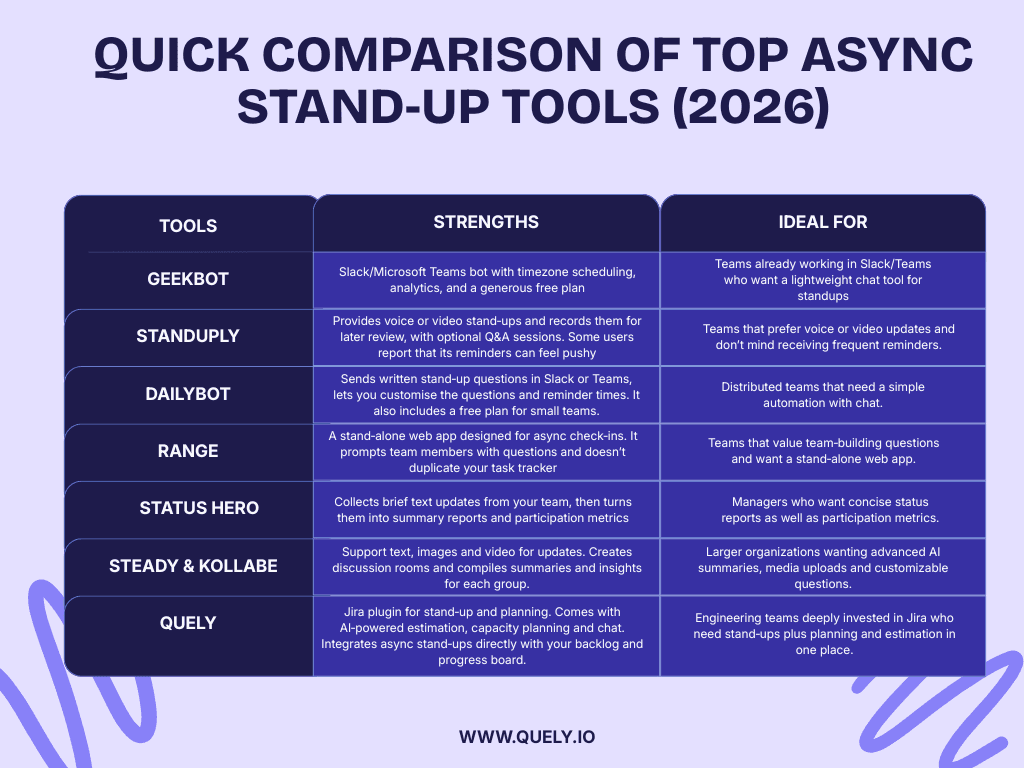
Quick Comparison of Top Async Stand‑up Tools (2026)
Recommended Tools for Async Standups in 2026
1. Quely
Best for: Teams that want asynchronous updates grounded in connected work, context, Signals, and Ownership
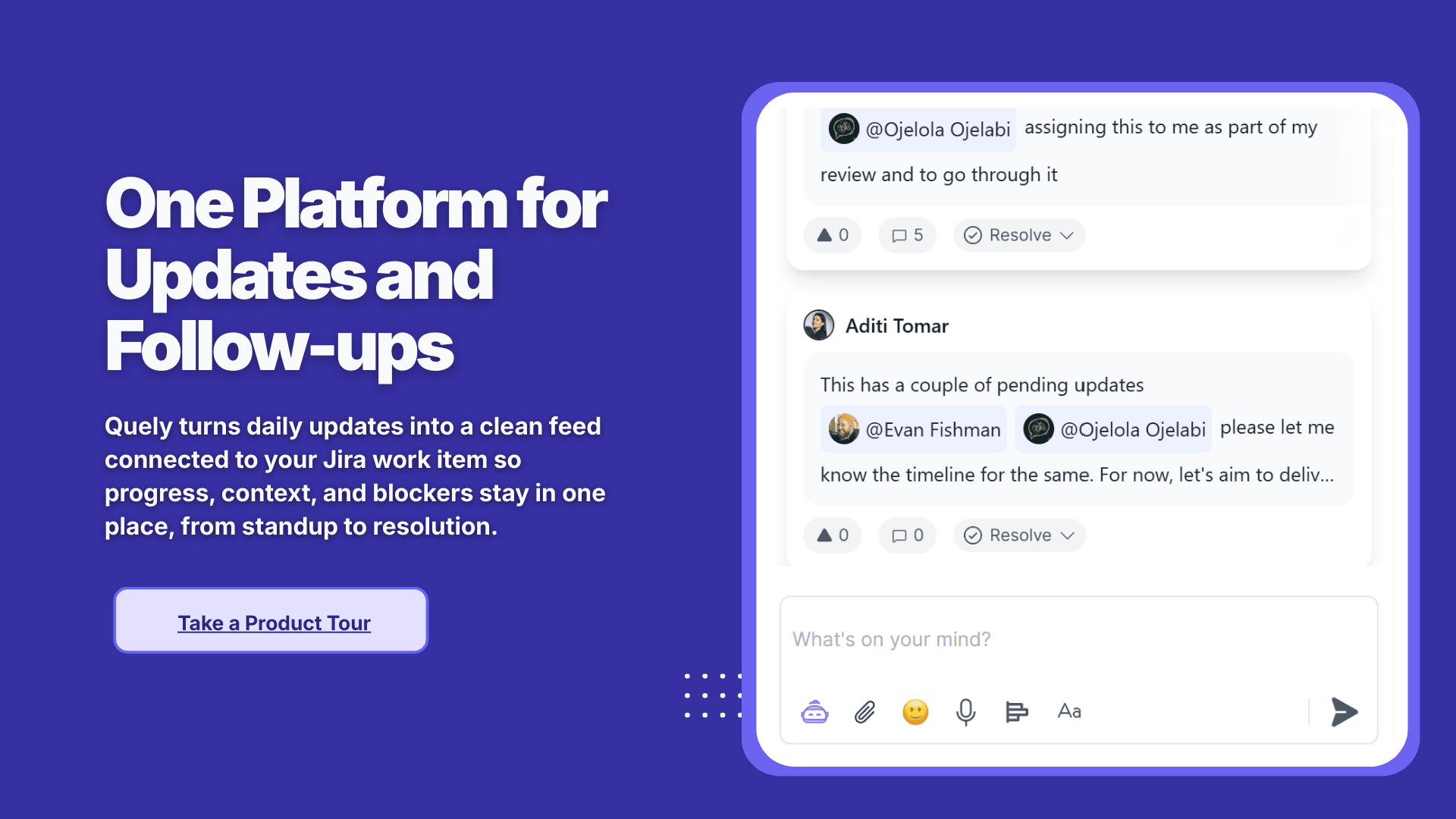
Quely is an intelligence layer across the systems teams already use. It can connect standup updates to the Work Units, synthesized Context Units, and Signals that explain the actual delivery state.
Type: Connected work-intelligence layer
Why teams love it:
Connects execution objects from systems such as Jira as Work Units
Synthesizes relevant information into Context Units
Uses Orbit as a conversational and analytical interface across connected Units
Surfaces decisions, questions, risks, dependencies, blockers, assumptions, action items, commitments, and themes as Signals
Uses Ownership to show responsibility, current commitments, workload, and available capacity
Uses Lenses to examine the same context from different delivery perspectives
Organizes related work and context within Spaces
Helps teams identify what needs attention without presenting Quely as the system that replaces every source tool
Potential drawbacks:
Not a dedicated standup bot, meeting recorder, timesheet, or resource-scheduling product
Requires teams to adopt a connected work-and-context model rather than a standup-only workflow
Verify current commercial terms directly with Quely
2. Geekbot
Best for: Teams already using Slack or Microsoft Teams who want a simple, plug-and-play solution
Geekbot facilitates asynchronous check-ins, daily standups, polls, and retrospectives within Slack or Microsoft Teams. Verify current customer and usage claims on the vendor’s official site.
Type: Text-based chat bot for Slack/MS Teams
Pricing: Verify current plans and limits on Geekbot’s official pricing page.
Why teams love it:
Extremely easy setup with little to no learning curve
Time-zone aware scheduling (each team member gets prompted at their local convenient time)
Excellent Slack/MS Teams integration that feels natural
Useful analytics dashboard showing participation rates and blockers
Potential drawbacks:
Pricing can add up for larger teams
Being text-only, it lacks visual or face-to-face elements
Success depends on team discipline in writing meaningful updates
3. Standuply
Best for: Teams wanting flexibility with text, audio, or video responses plus additional Agile ceremonies
Standuply markets itself as the "#1 Standup Bot" and digital Scrum Master. Beyond daily standups, it can run retrospectives, polls, and internal Q&A systems, making it a comprehensive Agile tool.
Type: Primarily text-based Slack/Teams bot with optional video/audio responses
Pricing: Verify current plans and limits on Standuply’s official pricing page.
Why teams love it:
Supports text, audio, and video responses for flexibility
Rich template library for standups, retrospectives, and surveys
Time-zone intelligent scheduling
Potential drawbacks:
Plan limits may change; confirm the current allowance before adoption
Text-only usage can feel monotonous without variety
Some team members may miss live standup spontaneity
4. DailyBot
Best for: Teams using platforms beyond Slack (Teams, Discord, Google Chat) who want team-building features
DailyBot is a modern async standup tool that works across multiple chat platforms. It positions itself as more than just a standup bot, offering mood tracking, kudos between team members, and AI-powered insights on team well-being.
Type: Text-based chat bot supporting Slack, Teams, Discord, Google Chat, and more
Pricing: Verify current plans and limits on DailyBot’s official pricing page.
Why teams love it:
Multi-platform support (not limited to Slack)
User-friendly interface with minimal learning curve
Fun extras like mood tracking and virtual high-fives
Strong transparency and accountability features
Potential drawbacks:
Occasional minor bugs reported (bot unresponsive on some days)
Editing submitted responses can be confusing
No built-in video capability
5. Range - The Culture Builder
Best for: Teams wanting structured check-ins that build both accountability and team culture
Range is a comprehensive check-in and team collaboration platform purpose-built for distributed teams. It combines daily updates with team-building elements like mood sharing and icebreaker questions, while integrating with tools like Jira, GitHub, and Trello.
Type: Text-based check-ins via web app with Slack/MS Teams integration
Pricing: Verify current plans and limits on Range’s official pricing page.
Why teams love it:
Structured format encourages thorough, consistent updates
Team-building questions alongside work updates
Insightful analytics for managers (participation, sentiment, blockers)
Potential drawbacks:
Requires using an external app (though Slack integration helps)
Some UI elements can be hard to find initially
Primarily text-based with no native video support
6. Steady
Best for: Engineering teams wanting data-driven standups with comprehensive project visibility
Steady is a lightweight check-in tool that integrates heavily with development and project management tools. It aggregates team member updates with activity from GitHub, Jira, and CI pipelines to produce comprehensive daily reports for stakeholders.
Type: Text-based check-ins with heavy project tool integration
Pricing: Verify current plans, trial terms, and limits on Steady’s official pricing page.
Why teams love it:
Aggregates updates and project data into single daily report
Strong Slack/MS Teams integration
Highly configurable questions and scheduling
Provides comprehensive project context through tool integrations
Great for proactive management and early issue detection
Potential drawbacks:
Verify current entry-plan and trial terms before adoption
Value depends heavily on consistent team usage
Daily reports can be lengthy for large teams
More utilitarian (lacks fun team-building features)
Choosing the Right Tool for Your Team
The best async standup tool depends on several factors:
For small teams just starting out: Geekbot or DailyBot may offer a low-friction workflow; compare current plan limits and platform support.
For Agile-focused teams: Standuply provides the most comprehensive ceremony support.
For culture-building: Range and DailyBot excel at team engagement beyond just status updates.
For engineering managers: Status Hero specializes in status reporting; Quely is better suited to connecting delivery updates with work, context, Signals, and Ownership.
For teams with fragmented context: Quely connects Work Units from source systems with the synthesized context needed to interpret them.
Making Async Standups Successful
Regardless of which tool you choose, success with async standups requires:
Team buy-in - Everyone needs to understand the value and commit to consistent participation
Clear expectations - Define what constitutes a good update vs. minimal effort
Regular review - Periodically assess if the format is working and adjust as needed
Hybrid approach - Consider combining async updates with occasional live discussions for complex topics
Getting Started
Most teams benefit from piloting two or three tools where current plan terms allow. Measure participation, unresolved blockers, decision latency, and meeting time; the tool must fit the team’s culture and receive consistent use.
With the right async standup tool, you can transform daily updates from a scheduling nightmare into a productive, even enjoyable experience that keeps your remote team connected and aligned.
Evaluate tools against your actual workflow, verify current pricing and integrations with each vendor, and run a limited pilot before wider adoption. See how to design the process itself.